Edward Mealy El (born Edward Mealy; September 17, 1870 – 1935 in Wilkerson, Mississippi, which was renamed Huntington and later abandoned.), often known as E. Mealy El, was an American religious leader who was Prophet Noble Drew Ali's successor as head of the Moorish Science Temple of America. He was appointed the first Assistant Chairman of the Moorish Science Temple of America by Prophet Noble Drew Ali on June 1 of 1927. On August 1 of the same year he received an appointment to General Chairman from the Prophet
Noble Drew Ali.
In February 1928, Mealy El was made Grand Sheik and Chairman of the Moorish Science Temple of America by appointment of the Prophet Noble Drew Ali. By the close of the first annual convention of the Moorish Science Temple of America (October 15–20) Edward Mealy El was promoted to Supreme Grand Sheik of the organizations highest tribunal and executive cabinet, the Supreme Grand Council. In all his appointments, he was unanimously approved by the "Grand Body", or, executive heads of all subordinate temples within the Moorish Science Temple of America. In February 1929, an annual corporation report filed with the Illinois Secretary of State lists Edward Mealy El as President of the Moorish Science Temple of America Inc.
Noble Drew Ali died on July 20, 1929, and his attorney, Aaron Payne Ali, tried to unite the Moorish Science movement under his leadership. He was unsuccessful, and several of Drew Ali's former disciples emerged to vie for power amidst the leadership vacuum. Mealy El stated that he had been declared Drew Ali's successor by the Prophet himself. In August, John Givens El, Drew Ali's chauffeur, declared that he was Drew Ali reincarnated. He is said to have fainted while working on Drew Ali's automobile and "the sign of the star and crescent [appeared] in his eyes".

Mealy El was present at the Second Annual National Convention of the Moorish Science Temple of America, or "Unity Conference," in September 1929. As the end of the convention neared, hours were spent discussing the Prophet's intentions. Around this time, John Givens El entered the chamber and sat himself on the Prophet's empty seat. He announced: I am back. I am the Prophet Noble Drew Ali, reincarnated, and Prophet Noble Drew Ali, the founder. We two are one in the same.
A silence fell over the convention chamber.Despite this, the convention delegates did not vote for Givens El to lead the Moorish Science Temple of America. Instead, with two-thirds of the votes, the grand sheikhs elected Mealy El as the first Supreme Grand Sheikh and C. Kirkman Bey as his Grand Advisor. Ultimately, the election was not accepted by all members, and both Givens El and Kirkman Bey went on to lead their own factions of the Moorish Science Temple. Kirkman Bey took Mealy El to court to try to gain legal leadership over the denomination, but lost each time. On My 7, 1931, Judge Eberhart ruled in his favor in the case of C. Kirkman vs. E. Mealy El.In response, Kirkman Bey created his own organization, called the "Moorish Science Temple of America, Inc," taking most of the Moors with him.
By then, Mealy El only retained leadership over Temple No. 1 in Chicago, but possessed Drew Ali's original documents.Several years after the leadership feud, Mealy El suffered a stroke and was sent to live with his family in Mississippi by his wife, Dealia, who was unable to care for him. He died in late 1935 while on a business trip, no longer living in Chicago due to infighting. Following his death, Dealia Mealy El inherited Noble Drew's papers and used them to place, William Morris El, who she was rumored to have started a relationship with after her husband's death, in the position of Supreme Grand Sheikh. Over time, his leadership was rejected by many of the members of Temple No. 1. In response, some of them turned Noble Drew Ali's documents over to Charles Kirkman Bey, thus strengthening his legitimacy as Noble Drew Ali's successor.
Oscar Stanton De Priest (March 9, 1871 – May 12, 1951) was an American politician and civil rights advocate from Chicago. A member of the Illinois Republican Party, he was the first African American to be elected to Congress in the 20th century. During his three terms, he was the only African American serving in Congress. He served as a U.S.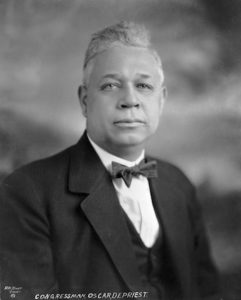 Representative from Illinois' 1st congressional district from 1929 to 1935. De Priest was also the first African-American U.S. Representative from outside the southern states and the first since the exit of North Carolina representative George Henry White from Congress in 1901.
Born in Alabama to freedmen parents, De Priest was raised in Dayton, Ohio. He studied business and made a fortune in Chicago as a contractor, and in real estate and the stock market before the Crash. A successful local politician, he was elected to the Chicago City Council in 1914, the first African American to hold that office.
In Congress in the early 1930s, he spoke out against racial discrimination, including at speaking events in the South; tried to integrate the House public restaurant; gained passage of an amendment to desegregate the Civilian Conservation Corps, one of the work programs under President Franklin D. Roosevelt's New Deal; and introduced anti-lynching legislation to the House (it was not passed because of the Solid South Democratic opposition). In 1934, De Priest was defeated by Arthur W. Mitchell, the first African American to be elected as a Democrat to Congress. De Priest returned to Chicago and his successful business ventures, eventually returning to politics, when he was again elected Chicago alderman in the 1940s.